Model announced for Argentina would replace the pickup made in Paraná since 2015
By George Guimarães | Translated by Jorge Meditsch
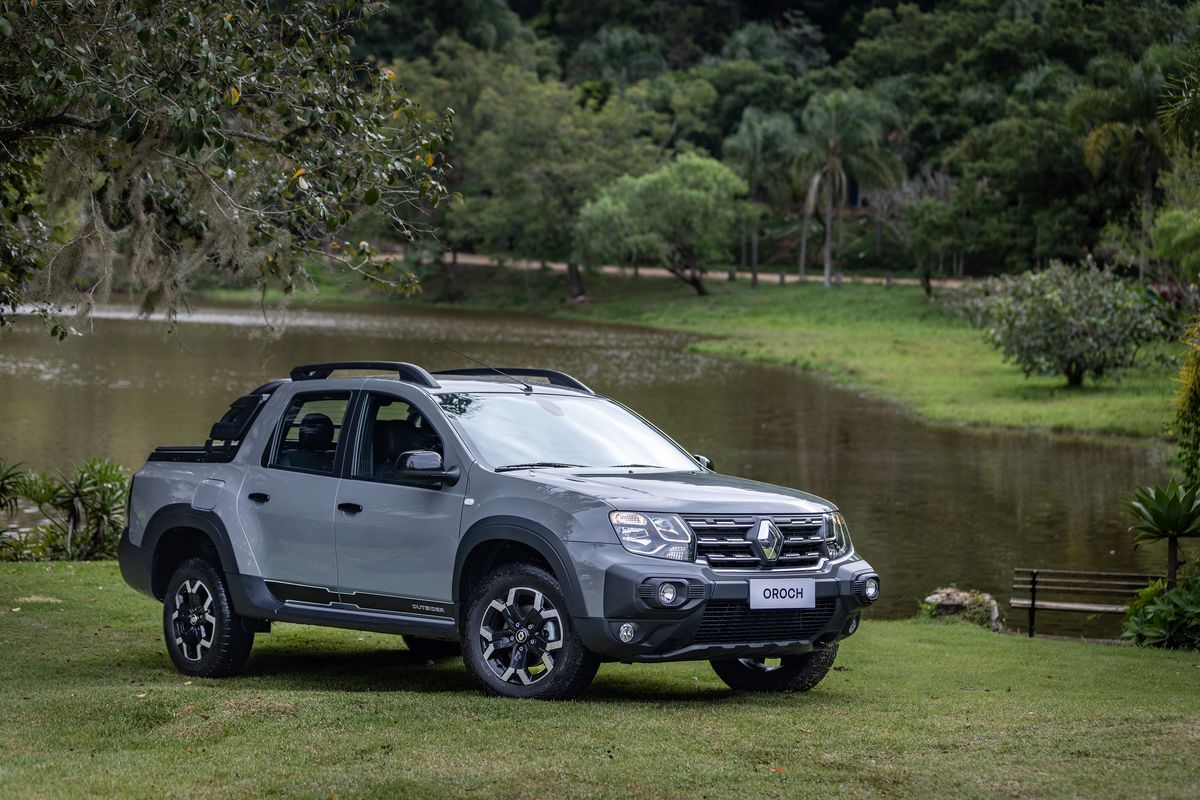
The Renault-Nissan-Mitsubishi Alliance has just announced that a half-ton pickup will be developed by Renault and produced with Nissan in Cordoba, Argentina, and left an open question: will the Renault Oroch still be produced in São José dos Pinhais, PR?
The answer shall take some time. But it will be difficult for Renault to find customers for two compact pickups in the region, mostly with the new one shared with Nissan.
Larger and with a 680 kg cargo capacity, the Oroch appeared as an intelligent alternative for consumers that had to opt between smaller models, such as Fiat Strada and Volkswagen Saveiro – the two best-selling small pickups in Brazil for decades – or much larger and more expensive models, built on chassis, diesel-driven and able to haul one ton.
But Fiat perceived the potential of the new segment created by Oroch and, one year later, launched the Toro, the sales leader since then. A new competitor shall arrive this month at the Chevrolet dealerships: the new Montana, which from the old version, kept only the name.
Renault shall find a fast solution to remain competitive among the light commercial models, a segment that has all the potential to keep expanding in the region. Last year, pickups were more than half of the vehicles produced and close to 30% of the market in Argentina. In Brazil, light commercials, including vans, had 380 thousand units licensed, 19.5% of the light vehicles sold.
Renault got a share of only 5.9% of the segment in Brazil, less than its 6.4% in passenger cars. Considering only pickups, the French brand’s share was even lower, 3.7%. Of the 325 thousand pickups licensed last year, Fiat sold 162 thousand, a 49.8% share.
Oroch’s disadvantage is also enormous in front of Fenabrave’s large pickups ranking leaders. While the direct competitor Toro got over 49.5 thousand units licensed and the Toyota Hilux, second placed, 48.6 thousand, the Oroch sold just 12 thousand units, a 500 monthly average.
This timid result happened even with the first styling changes promoted by Renault and the new 170 cv 1.3TCe turbo flex engine. Since its launch in the second half of 2015, Oroch’s best result was 14.2 thousand units in 2016. In seven years, it sold 80 thousand units.
Cássio Pagliarini, Bright Consulting’s associate consultant, believes Renault had the merit to create the segment, but failed for not giving Oroch the characteristics explored later by the Fiat Toro, as diesel and 4×4 versions. “It also lacked a more modern design and automatic transmission”, he adds.
For the consultant, it is probable that the future Argentinian compact pickup would replace the Brazilian Oroch, possibly keeping the name.
The migration would make sense, according to Pagliarini. The Argentinian pickup market is strong; these vehicles’ production is already concentrated there, and Renault needs to improve its trade balance between the two main Mercosul poles. Currently, it does not import vehicles from Argentina to Brazil.
Picape híbrida teve somente 1,8 mil unidades licenciadas em quase dois anos
O presidente da entidade prevề cerca de 10 mil visitantes entre os dias 17 e…
Primeiro SUV da plataforma Neue Klasse chega por aqui com autonomia de 570 km ao…
Algumas empresas conseguirão ampliar seus volumes, enquanto outras perderão espaço mesmo em um mercado maior…
Foram financiadas 3,78 milhões de unidades novas e usadas no primeiro semestre, 10,9% a mais…
Executivo responderá mundialmente pelo cumprimento de metas do grupo